Spotlight: Deodaat

Updated: Dec 5, 2025
“As my friends say, I'm sometimes a bit too positive. It's a way I love looking at the world, I see endless possibilities instead of the darker side or the things that could go wrong. I see things that could go right. That's a big motivation for me."
While it's been only fairly recent and my Birdcage Radio Spotlight "interview victims" count is still rather low, being given the privilege to speak to these passionate and talented folk has been nothing short of inspiring. Beyond that, this opportunity has also shed some light into the whole world of producing and performing music of which I knew close to nothing about. And frankly, I still don't.
Meeting Deodaat was no different.
As I walked into his home for our interview, I was greeted by a huge smile and on his wall being projected, was a concert. He excitedly tells me about Vulfpeck’s legendary Madison Square Garden concert, asking me to pay attention to some of his favourite parts. “They enjoy playing together so much, it is awesome,” he says. All around his apartment, I notice vinyl records carefully arranged, posters, collectibles and art. Instead of band posters, I discovered paintings by his sister. “I love her work and the calmness and use of nature,” he tells me. A music lover’s home, but one designed by someone who also appreciates silence. It made perfect sense. It feels exactly like what I'd imagine a music aficionado's place to look like. But I already knew that about him even before having met him.
He then shows me a rare South African Kwaito vinyl he had every right to be enthusiastic about. “One of my first Kwaito records,” he shares, carefully holding it. There are apparently only six people on Discogs who own this particular one. Six. "Okay, great" I think to myself. I am way out of my league here, desperately holding on to my only self-proclaimed musical talent of guessing songs from the 90s within the first 5 seconds of them playing. That and my hand-farts. And this guy is out here preserving cultural artefacts.
But that’s not all. Prior to our meet, he shared some of his history and past work - one of which was the highly intriguing Deodaat's Diary. Over a span of four months, he journeyed through France, Spain and Portugal, where he explored the musical history of these countries, collected records in context, and met inspiring music lovers in the process. In this video diary of his, he connects the dots as to how the 70s disco revolution influenced the modern music scene. So from the get-go, I knew class was in session and I was in for some proper schooling in the world of music by Deodaat.
"I started off in France then I dove into the 70s revolution - the French are really good at electronic music so I touched a little on that. Then I worked on the second place, Spain, and focused on that era of time and did the same for Portugal. It was my gap year and I had a lot I wanted to do" he shares.
"I wanted to search for myself and know if I could do it. And I knew that if it had to happen, it had to happen then. But that also made every step I had to take be real calculated and necessary. I hated that very quickly. I'm really glad I travelled for four months and took the time to really dive into those things and just do it for me. It was a diary for me to recall the places I went to and it was always a whole week in the theme of that music. This whole process really helped me to find out what music means for me and what makes me feel good about music" Deodaat continues.
Deodaat's Diary was evidently where he learnt a lot, expanded his horizons, discovered new techniques and now, helps him produce a bit better. This gap-year journey of his ended in November 2024 but his fascination and involvement with music started much, much earlier.
Deodaat's parents always sang and played the guitar to him and his sisters a lot. He was raised Christian, so gospel music and singing together was a big part of his childhood. "I was a very busy kid and I liked music a lot. My sister played the trumpet in a band in the small village where I come from and I wanted to play other instruments and my parents said go drumming. They wanted me to get all my energy released through it so at 7, I started playing in a drum band."
Drumming turned out to be a huge part of his step into the musical world and at 12, he was drumming for the children's section of a big band and as he got older, he became a drummer of the main fanfare band itself.
"I was 9 when I got accepted into the fanfare band to perform on the streets. I was a very small boy and those carriers for the drum kits were too big for me, so my dad used to customize it with rubber bits so I could carry it and walk for 7 or 8 kilometres.
My parents were concerned and told me if it's going good, to give them a little thumbs up signal and if it's bad, they'd come get me out. Also because I was the youngest, people were always teasing me and saying stuff like I wasn't allowed to smile, laugh or make any contact with anyone in the crowd while performing in uniform. So I was like a very serious 9-year-old kid on the drums. [laughs] I was playing together with my elder sister and my younger sister also joined the band at a later point."

Rhythm may have been fun, but discipline was non-negotiable. Those roots are why he leans into percussion-driven genres today. Think disco, tropical beats, Afro and Latin influences. You know, music that demands movement. “If you play two hours of full disco, it can be too much,” he says. “Dynamics matter. Percussion creates space and suspense.”
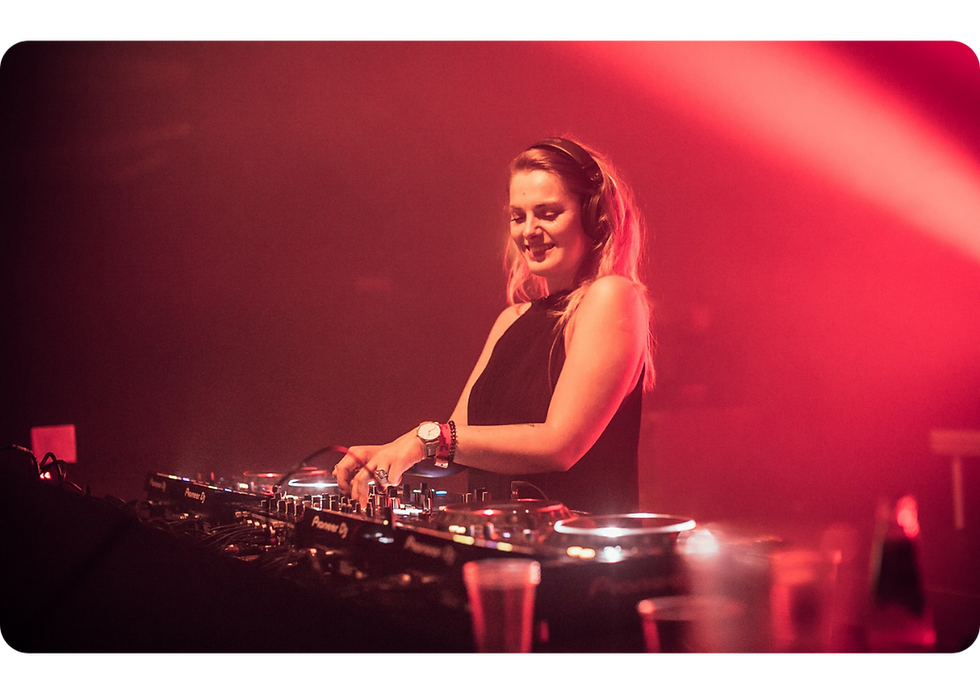
DJ’ing began for Deodaat once he moved to Utrecht for his medical studies. A controller first then vinyl later. And vinyl was the game changer.
“I played the drums till I was 18 and started studying here in Utrecht. That also forced me to search for other ways to satisfy that creative need in me and to play music. That's when I bought my first controller, so that made me switch from real-life playing to the electronic part of it. That kinda matched pretty good with me ‘cause DJ’ing is mainly a rhythmic thing in the core then you try to match the melody of different tracks. I knew music theory from playing in the fanfare band and that came in useful. In the third year of my studies, I started a band as well and started playing bass and that's what also really helped with fit in with the music knowledge I already possessed.
It wasn't until the last few years that I started collecting vinyl and learnt to play the older kinda discos by ear because you learn to listen and make beat matching easier. When you play on vinyl you don't see anything and are just reliant on your ears.”
Of course, curiosity gets the better of me and I prod on whether he remembers his first vinyl. He did. “The first vinyl that I got was from my parents. It was a live recording of Dire Straits’ 'Alchemy'. It also has a live recording of Romeo and Juliet on it. It's very cool and I was 16 when they gave it to me. All these are disco and house but this box right here (he shows me some of his collection), is where more of the Rock stuff are at. This one is my favourite.”
He shares that playing vinyl really matured his play style because of the complete freedom is allows. “If you can play on vinyl, you can play almost everything,” he says.
But that’s not all it takes. Deodaat used to be what he himself refers to as a bit of a people pleaser, so it was sometimes difficult to play the slower or less melodic side of his sets.

“Because I'm afraid they won't like it, won't stay for the music or won't trust me in the process that we're going through. But I've accepted it a little bit that it's part of my story that I want to tell and you can't have highs without the lows - but it's difficult. You have to feel at home behind the decks and just believe.
Last year I really matured with a lot of different music. And that was also one of my problems, in the beginning with a set I could be a bit too eclectic. Like go from place to place, a bit of house, then a bit of jazz but you also have to take people with you on your journey because some connections that may be very logical to me might make no sense to the crowd. And building tension is very difficult as well because you need to match songs in energy but also the energy of the drum kits, the percussions, that's what I learnt a lot this year - how to take people with you on the story, the time to tell and captivate the energy and still build on it bit by bit.”
On some of his fond memories, he shares “I had the honour of playing at the NAR a couple of weeks ago and I was able to go back two weeks later. And that's a sign that people like the vibes you bring, and the energy and they have the attention for the details and that's cool to have people sorta validate your path. To see them enjoying it and wanting more. I like that. I think Utrecht is a really good place for people who really love music. And I felt at home behind the deck, I think that's the most important thing for me - is that you feel that the place you're playing fits you and suits you. This gives you a lot of creative freedom to do the things you like. It was like a nice little test for myself and I'd like to think I passed it with flying colours. I put a lot of effort in it, a lot of my friends were there and it was a very reaffirming moment that made me believe I can do this. It was a goal for me."
He only plans his opening track, letting the set evolve like a conversation. “The vibe of the people decides where I go,” he said. Intention into joy. “For me it feels like a conversation between me and the people on the dancefloor.”
As we talk about producing, his face lights up. He spent years trying to get his work to sound like the way he hears it in his head. “I produced on Ableton and the first two years, I had to look up everything on YouTube, that can sometimes be pretty frustrating to have a big idea in your head and not the right toolset to make it materialize.”
Now, he finally has a track he is excited to play out. It is called Gospel Truth. House with gospel influence. Bass and trumpet by him. Keys by his friend Big-Floppy. “It is a set ender,” he tells me, proud in a way that feels very much earned.

When asked about his artist name, I find out it is simply his second name. “That's what my parents called me. Deodaat is Latin, a Christian name. Deo means "god" and daat means "given", so God-given. They thought I was a present from god and I think music is a present from god as well and I thought why make up a name when you already have a pretty original name as well. And feels close to heart too. It's also funny because in high school, I'd get made fun of because of that name and now I've fully embraced it.” Deodaat. God-given. There simply is no denying this guy’s calling, I think to myself while admirably listening to his stories. “Music feels like a gift,” he said. “So it fits.” Once teased, now embraced.
This year he pressed pause on medicine. Not forever, just for clarity. He wanted to know if music could be more than a side love. And yes, there were nerves. Other people his age seemed to be miles ahead. But somewhere along the way, peace arrived.
Just like what Deodaat says he’d tell his younger self, “Everything will work out. Follow your passions. Find out what makes you happy.”
Medicine and music appear to sit on opposite ends of the spectrum, but he sees the connection daily. In one world, you stand with people through some of their hardest days. In the other, you get to help them forget those days for a while. “I think both worlds are beautiful in their own way and inspire me on different levels. Both keep me in balance and happy,” he says. “I would not want to be only a doctor or only a DJ.”
It is not without its challenges. He has pulled 40 to 50 hour weeks at the hospital while performing two or three nights. The fact that one of those jobs is unpaid adds a poetic twist. Yet he laughs. Because honestly, he loves both.
What keeps him going? Well, he sees possibilities in everything, I think. “As my friends say, I'm sometimes a bit too positive. It's a way I love looking at the world, I see endless possibilities instead of the darker side or the things that could go wrong. I see things that could go right. That's a big motivation for me. Things I learnt when growing up, being grateful for everything you have, gratitude is very important for me!”
There was still so much I wanted to dig and find out, fueled not only by my own intrigue but more so this unwavering drive and undeniable passion Deodaat possesses. But alas, realizing my tendency to rant and how this interview is already getting very lengthy, I move on to the topic of Birdcage Radio.

Birdcage Radio arrived into Deodaat’s life like a missing puzzle piece. A place where he could share his story through music rather than a request list, starting off as a gradual slide that became a full sprint. “I started playing during the second year of my studies,” he said. Music was a lifeline for him and his friends. They found each other at parties and when the world shut down in 2020, they turned their living rooms into clubs. “We would play for twelve hours straight, three times a week. Music kept us going through the pandemic.”
After restrictions lifted, student parties followed, but he quickly learned that playing crowd pleasers does not always feed the soul. He wanted a place where he could tell his own story. That is when a mutual friend recommended he reach out to Birdcage Radio.
He played a show. Then another. And then came the moment he did not expect. “One day, Nicy asked if I wanted to host a monthly show.” He smiles remembering it. The show became an extension of the gatherings that got them through lockdown. Friends dropping in, blending genres, exploring each other’s tastes. A small rebellion against sameness.
“It was like a playground where we could experiment and mainly have fun.”
Two years later, that monthly show was still running. And after returning from his travels, he contacted the Birdcage team again. This time he wanted to help build the space that once made room for him. He stepped into programming because he believes the magic lies not just in playing music but in uplifting the people who want to share theirs.
He describes it honestly. “Programming is like placing the right person on the right spot,” he explained. It is curation, but also caretaking. Birdcage has a show almost every day which means many artists, many volunteers, and many moving pieces. “It is a bigger operation than I thought,” he laughed. But the joy outweighs the logistics. Helping others tell their musical story brings him a kind of joy that is difficult to fake.
“I love seeing someone walk into the studio smiling because they get to tell their story.”
Which raised my query on his view of our beloved city’s music scene. He sees Utrecht’s music scene changing. More collectives. More curiosity. Less focus on commercial hits and more on connection. Birdcage, Kabul, NAR. These are spaces that feel alive. “There is so much coming to this city,” he said. “I think Birdcage Radio plays a big role in helping artists discover who they are. A lot of cool artists have started here. It feels good to be part of that movement.”
Note: Since the time this interview took place, (ahem, which was a while ago) Deodaat has passed the Birdcage Radio programming torch on to the next worthy successor while he focuses on his studies and allocates whatever time he has left into his own musical adventure. Links to his music and work can be found at the end of this interview.
And so he now lives in two worlds. Hospital halls and sound systems. Healing and hedonism. Service and celebration. Both equally human. Both equally necessary.
There is much to respect about and learn from Deodaat and to me, having this interview as one of my first for Birdcage Radio’s Spotlight series was such a privilege. It also took a ridiculously long time to put together (my apologies, Maries) because as you can see, there was simply a lot to share.

He is following rhythm, trusting instinct and collecting memories along the way. It is evident that music is guiding Deodaat. And he is listening - and Utrecht is lucky to be dancing right beside him. I left his apartment knowing two things: he is nowhere near done, and my homework in learning more about music has only just begun.
Follow Deodaat's beautifully inspiring and euphonious journey:
YouTube: https://www.youtube.com/@Deodaat
Soundcloud: https://soundcloud.com/deodaat


Comments